iPhone 12 may still use Lightning interface

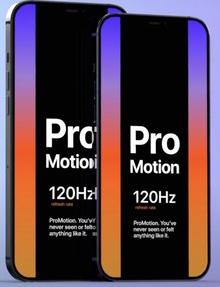
The iPhone 12 series, which will be released in the second half of this year, may make you wonder about the interface. The iPhone 12 series will come standard with 5G, which may be what many consumers want to see. However, according to the latest news, the iPhone 12 series will still use the Lightning lightning interface, which is confusing.

iPhone2 03 - iPhone 12 may still use Lightning interface

Apple did design the iPhone 12 series prototype with Type-C interface, but it has not been mass-produced. Considering that the iPad Pro has adopted the Type-C interface, the use of the new interface in the iPhone 12 series is a matter of success, and the situation of the unification of the Type-C interface is already very obvious. There is no need to continue to use the Lightning interface. But Apple did.

If the news is true, then you may only use the Type-C interface on the iPhone 13. Of course, one possibility is not ruled out, that is, Apple wants to eliminate the interface on the iPhone and completely adopts the wireless transmission method. However, from the current point of view, this method is still far from actual use.

*More Apple iPhone Series batteries to click here.

MateBook X Pro 2020 new laptop review

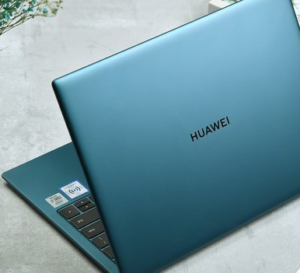
Nowadays, business notebooks are gradually separated from thin and light notebooks, becoming more and more powerful and more and more secure. People who pay attention to business notebooks pay more attention to their privacy and product stability. The leader in the notebook — Huawei MateBook X Pro 2020.

matebook x pro 03 300x273 - MateBook X Pro 2020 new laptop review

Configuration: i7 10510U / 16GB / 1TB / MX250

For high-end business professionals, the notebook is not only a productivity tool, but also a symbol of fashion identity in business travel. The Huawei MateBook X Pro 2020 is a product that is both “highly acclaimed and well-received.” From the perspective of media and e-commerce evaluations, it has received rave reviews and popular sales.

The Huawei MateBook X Pro series has previously launched three color schemes of deep grey, light silver and cherry-pink-gold. After the upgrade this year, the Huawei MateBook X Pro 2020 model has added a new jade-cold green color scheme. The transparent jadeite is clean and free of impurities. It has a calm atmosphere and fashionable temperament. For the new color, many users call him “atmospheric appearance, a piece of art.”

The newly upgraded 10th generation Intel Core i7-10510U / i5-10210U processor provides Peng Pai performance for the Huawei MateBook X Pro 2020. With 16GB of memory, the system is smoother, and work and learning are more efficient. It is equipped with a PCIe high-speed solid-state drive. To make creativity more efficient and stable. At the same time, Huawei MateBook X Pro 2020 uses NVIDIA GeForceMX250 graphics card, 2GB GDDR5 independent video memory, performance is 3.5 times that of integrated graphics.

In addition, Huawei MateBook X Pro 2020 is also equipped with a 56Wh large battery, equipped with Huawei’s self-developed intelligent power saving mode, and the battery life is also good enough. In terms of charging, it is also equipped with a 65W adapter, which can not only fast-charge the notebook, but also fast-charge some mobile phones that support Huawei’s super-fast charge, which truly achieves multi-use. In addition, the integrated design of the power supply and fingerprint recognition sensor has also been well received, while continuing to retain the unique hidden camera design on the keyboard.

All in all, Huawei MateBook X Pro 2020 is an excellent business flagship both from inside and out, if you are planning to get started, then Huawei MateBook X Pro 2020 is a good choice!

logo - MateBook X Pro 2020 new laptop review

*More low-price HUAWEI Series batteries online to click the following link:

HUAWEI TABLET BATTERIES:

https://www.batteryclub.org/pro_main/318.html

HUAWEI PHONE BATTERIES:

https://www.batteryclub.org/pro_main/88.html


Misconception of battery self-discharge

Self-Discharging After Charging Some friends say that the battery voltage drops rapidly after charging, indicating that self-discharging is too fast. The reason is that the charging voltage is higher than the actual battery voltage due to the polarization of the battery during charging.

Voltage Drop Process After Charging-This is the battery voltage process from the charging voltage to your own voltage. The actual battery voltage that is the result of the charging voltage is called overcharging, rather than the so-called “virtual power”, and in electrochemical terms there is no name for virtual power. Therefore, the voltage drop after charging is mainly the loss of overvoltage, the rate of self-discharge between them is very small and can be ignored. In addition, it takes more than 4 hours for the voltage to stabilize substantially after charging, and when charging is completed with a constant current or constant voltage, the difference in pause time is not so large.

7 Related Knowledge of Laptop Ports

First, the laptop power port
The notebook power port is a necessary port, which is used to supply power to the notebook and charge the battery. Notebook power port generally include circular power port, square power port, and USB Type-C power port. Do not mistake the square power port for USB. port. Among them, the circular port is the most common, because the diameter of the circular port is different because of different specifications.

Second, the notebook USB port
The USB port is the most common port in the computer. At present, the common USB port are USB 2.0, 3.0, and 3.1. Higher versions represent faster speeds, but there are special cases. For example, the speed of USB 3.1 Gen 1 is the same as USB 3.0. Both are 5Gb / s. There are two types of common USB port: Type-A and Type-C. Type-A is the most common. Type-C is an port that has become popular in recent years. The most obvious advantage of Type-C is that it supports positive and negative plugs. It is very convenient to insert it wrongly.

Type-C also has a special form, which is Thunderbolt 3. The Thunderbolt 3 port can not only be used as a conventional USB port to transmit data, but also be used as a video output port to connect an external display. It can even supply power to a notebook or external device. It is a very comprehensive port. Generally, there will be a small lightning logo next to the Thunderbolt 3 port, and users can distinguish it based on this logo.

Third, the video port
The video port on a notebook computer is generally used for external displays and extended screens. There are three types of video port: VGA, HDMI, and DP. The best port is DP, followed by HDMI, and the worst is VGA analog signal video port. DP is divided into two types: standard DP and Mini DP. Mini DP is smaller in appearance. Standard DP port is rare. Most laptops currently use Mini DP port.

Fourth, the network port
The network port is also called RJ-45 network port. It is a wired network port. After connecting the network cable, it can realize the Internet access function. In addition to connecting the network cable, the notebook has a built-in wireless network card, which can also achieve wireless Internet access.

Five, audio port
The diameter of the audio port jack is 3.5mm, which can connect headphones, stereos and microphones. Generally, the green jack is the audio port for headphones and stereos, while the pink jack is the audio port for microphones. The color is marked with an icon.

Six, SD card reader slot
SD card reader is used to connect the memory card of camera or mobile phone. SD card reader is divided into standard SD card reader and Micro SD (TF) card reader, which correspond to standard SD card and Micro SD card respectively. As the name suggests, the Micro SD card is smaller than the standard SD card, so the Micro SD card reader on the notebook is also smaller.

Seven, security keyhole
The security keyhole is a function to prevent theft of the notebook. It can only be used with a security lock. The security lock is not included with the notebook. We need to buy it.


5 Common Sense About Desktop Power Unit

1, what is active PFC?

Active PFC is mainly composed of high-frequency inductors, switching tubes, capacitors, and control ICs. It can be simply summarized as a step-up switching power supply circuit. This circuit is characterized by complex structure, but has many advantages: power factor is as high as Low loss and high reliability, input voltage can be from 90V to 270V (wide input), etc., because the output DC voltage ripple is small, so the power supply using active PFC does not need to use a large capacity filter capacitor, so we choose the power supply It depends on whether the product adopts active PFC.

2, what is the conversion efficiency?

Answer: Because the power supply is working, some departments’ electrical energy is converted into heat loss. Therefore, the power supply must minimize heat loss. Conversion efficiency is the percentage of output power divided by input power. The 1.3 version power supply requires a minimum conversion efficiency of 70% at full load. In version 2.0, the recommended conversion efficiency has been improved to 80%. Selecting a power supply with higher conversion efficiency can help us save more power.

3. What is 80PLUS certification

PLUS80PLUS certification is actually a sign of high power conversion efficiency. The certification requirement is to integrate the internal power supply of the system to enable the power supply to achieve 80% power efficiency at load points such as 20%, 50%, and 100%. 80PLUS-certified power supplies will have higher conversion efficiency than ordinary power supplies, while also saving energy and money. Batteryclub currently. All desktop power supplies provided by org are provided by 80plus certified manufacturers to ensure safety and reliability.

4. What is the rated power?

A: The rated power refers to the maximum load of the PC power supply under uninterrupted and continuous work. The rated power represents the true load capacity of a power supply unit. For example, the rated power of a power supply host is 300W, which means 24 days a day. When working continuously for hours, 365 days a year, the sum of all loads cannot exceed 300W. But in fact, the power supply has a certain degree of redundancy in order to be able to operate normally when the output power of the power supply reaches a full load, and to avoid damage to the power supply and other components to burn.

5. What is overpower protection?

Answer: In addition to the rated power, there is also a data called “overload protection (OPP)”. Overload protection means that the load of the power supply continues to rise and reaches a certain point, and the power supply is automatically cut off to avoid overcurrent damage to the power supply or other parts of the computer. The OPP value is usually about 1.3 times the rated power. Between the rated power and the OPP, there is a “blind zone”. For example, if the rated power is 300W and the OPP is 370W, then this area between 300-370W is a “blind zone”. If you stay in this zone for too long (usually it can last for tens of seconds), it may cause the power supply or other parts of the computer to burn out.

PC power supply specifications

Desktop computer power supply specifications are divided into:
*Dimensions
* Connector specifications *
* Modular output line

★ Dimensions
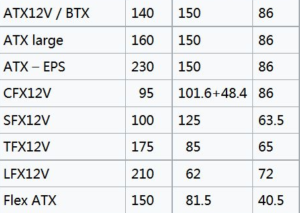
The standard size of the ATX-specific PC power supplies currently in use is: length 150 mm x width 140 mm x height 86 mm.

In fact, in addition to strictly matching the width and height, manufacturers can customize the length of the power supply. Sometimes, even if the power supply is of the same brand but different models, the length will be different.

In addition to the standard ATX specifications, there are SFX, TFX12V and other small size specifications, which are used by MicroATX, FlexATX, mini-ITX and other small size motherboards and enclosures, and their cooling ducts are deliberately adapted to small size systems.

Power supply size standard

power supply standard 300x213 - PC power supply specifications

★ Connector specifications
Generally, a power supply will have these connectors:

◇ DC output group

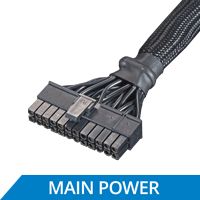
mainpower - PC power supply specifications

“PC Main”
PC main power connector (often referred to as “P1”): This connector is used to connect the main power of the power supply to the main power socket of the motherboard to power the motherboard.

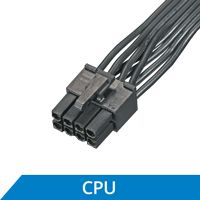
cpu - PC power supply specifications

“ATX12V”
4-pin power connector (also called “P4 power connector”): In addition to the 20 / 24-pin main power connector, the second power connector is connected to the motherboard. This 12V is mainly used for the power supply of the CPU. At present, it has been developed into an 8-pin power connector, that is, the EPS12V standard. An additional 4-pin is added to the original 4-pin to accommodate a higher current to meet a higher power consumption CPU.

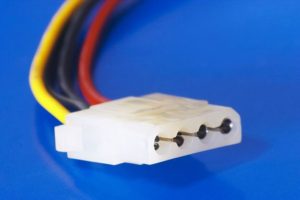
p4 300x200 - PC power supply specifications

D-type large 4-pin connector · “Large 4-pin” peripheral power connector: This connector is the standard power connector for almost all previous hard disk drives, and until now it is the standard connector for most power supplies. In addition to hard disk drives, it is also used in various motherboard expansion cards, chassis fans, and chassis lighting. There are also a large number of adapters for large 4-pin to SATA 15-pin power connectors.

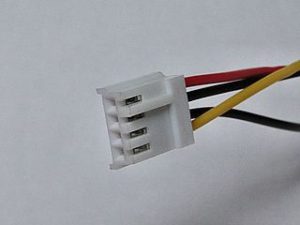
berg 300x225 - PC power supply specifications

“Small 4-pin” Molex power connector, also known as Mini-connector, Mini-Molex, Berg connector: is the work of Molex Japan branch, the smallest connection on the power supply Device, mainly for floppy drives. Its pin arrangement is similar to the “Large 4-pin”, and it is also standard equipment for most current power supplies.

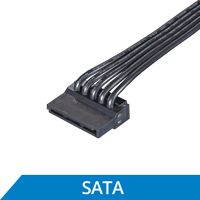
sata - PC power supply specifications

“SATA” 15-pin power connector: 15-pin connector for SATA devices, providing + 3.3V, + 5V and + 12V.

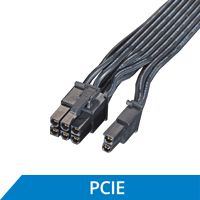
pcie - PC power supply specifications

“PCIe 6 + 2-pin” plug-in auxiliary power supply connector, also known as “PCIe 8-pin”: An upgraded version of the PCIe 6-pin plug-in power supply connector, compatible with 6-pin. External power supply for PCIe graphics cards.

AC input

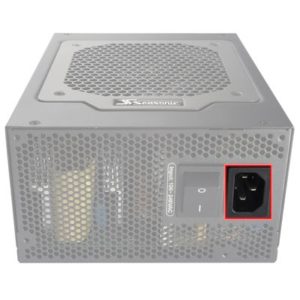
ac input 300x300 - PC power supply specifications

IEC 60320 C13 socket

An IEC 60320 (C13 / C14) -compliant connector (socket and plug) is used as the mains input.

★ Modular output line
◇ Modular and non-modular
The modular power supply (Modular PSU) provides expandable output wire sockets, as well as pluggable wires.

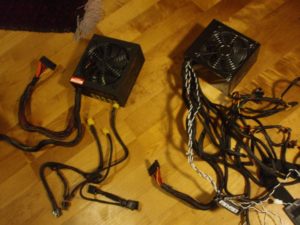
Modular PSU 300x225 - PC power supply specifications

Left: Modular power supply; Right: Non-modular power supply
Generally, traditional non-modular power supplies will reserve multiple sets of cables for peripherals for users to expand the components in the computer, and temporarily unused wires often occupy space in the case. Therefore, using a modular power supply, computer manufacturers and users can plug in the necessary wires due to the needs of the components in the computer, and leave the output power socket of the power supply empty if they are not used temporarily. Improved ventilation and heat dissipation due to the reduced number of wires in the chassis.

◇ Fully modular and semi-modular
According to whether the 24-pin and 4-pin / 8-pin power cables connected to the motherboard can also be removed, modular power supplies are also divided into full modular power supplies and semi-modular power supplies.

modular 300x300 - PC power supply specifications

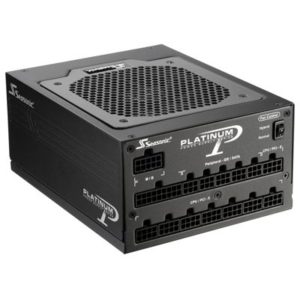
Seasonic SS-1200XP3 (fully modular)

All wires of the fully modular PSU are removable.

semi modular - PC power supply specifications

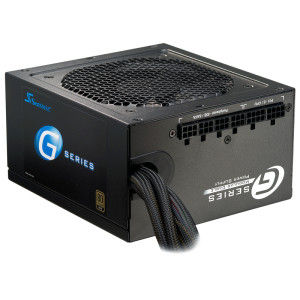
The Seasonic SSR-550RM (semi-modular) semi-modular PSU has only some wires removed, and the 24-pin and 8-pin used to connect the motherboard to the CPU are usually retained.

◇ Modularization = Modularization Modularization is also called “modularization”. For example, full modularization is called “full modularization” or “full module”; semi-modularization is called “semi-modularization” or “half-modulation” Modules “and more.

How many watts of power do desktops need?

★ 300-450 W Most enthusiasts and gamers will give up because this power range is “too weak”. The fact is that these power supplies can meet the power requirements of a modern low-power PC with a mainstream CPU and a single GPU. Unfortunately, this range is not very popular in the market and there is little competition, which means that users do not have too many product choices.

★ The range of 450-600 W is the most sold, and its product selection is also the most abundant. Even with overclocking, it is almost impossible for a PC consisting of a CPU and a GPU to exceed this range.

★ 600-800 W 600-800W power is very popular among gamers and overclockers. For dual-GPU gaming systems, they are powerful enough and provide enough margin for overclockers and Morse. Because excess power often makes people feel safe, this level of power is also very popular for users with only one GPU.

★ 800-1100 W This power range is suitable for high-end dual or triple GPU computers. Because we believe that whether it is a high-end gaming system or a professional workstation, long-term reliability is absolutely necessary, and we cannot choose a very cheap power supply within this power range.

★ 1100 W or more If you need a power supply with this output, this means that you have the opportunity to use a system with at least three high-end GPUs or very powerful dual CPUs with a lot of other equipment. These power sources are also used in advanced servers and cryptocurrency (such as Bitcoin) mining systems. In other words, these power supplies will power some systems that have very important functions and are quite expensive. Therefore, within this power range, selecting a “valuable” power supply is a complex process because the power supply must meet very high reliability standards.

How the laptop battery threshold works and how the battery threshold is set

When the battery threshold is not set:
* As long as the power charger is connected, the battery will be charged regardless of how much power is left.
* After the battery is fully charged, the charging operation stops and the power supply is disconnected from the battery. The computer only relies on a power adapter.

When setting the battery threshold:
* As long as the power is connected, the battery will only be charged if it is within the threshold range.
* If the battery level is outside the threshold, the charger will disconnect the battery and the computer will only rely on the power adapter for charging.

However, whether the battery threshold is set or not, does not affect the change in the number of cycles. So why do some business laptops introduce a “battery threshold”? In fact, this is just a feature that manufacturers use to make better use of computer design. The purpose of this function is to slow down the decline of the battery as much as possible when the battery is in a long-term storage state.
Therefore, if the computer is connected to the power adapter for a long time without using a battery, setting the power threshold can protect the battery to a certain extent.
Generally, the default threshold of Thinkpad series computers is 55% ~ 60%. Other brands of computers may also be 50% ~ 65%.
In fact, setting the battery threshold is equivalent to disconnecting the power adapter from the battery.
However, because everyone’s habits of using the computer are different, the actual battery threshold can be customized according to personal preferences.

What to do if the cell phone battery is swelling

Battery swelling and short circuit are two different things. Bumps do not necessarily have safety risks, but short circuits can cause combustion and explosion. However, it must be noted that to a certain extent, battery packs may also have potential risks. When there is a bulge, as long as you stop charging and using it in time, it is basically safe.

Let’s first understand the mechanism of battery bulging. In simple terms, battery bulging is due to the reaction of the battery electrolyte, which generates a large amount of hydrogen, carbon dioxide and alkane compounds, squeezing the battery case, and making the battery case swell.

The main reasons for generating gas are the following: the battery is overcharged, the battery is overdischarged, the battery is affected by high temperature, the battery is used for a long time, the battery has a design defect, and other unexpected conditions (such as welding Glitches pierce the surface of the battery, etc.).

How to avoid battery bulging?

1. Don’t charge for too long;

2.Use the original charger;

3.Keep the charging environment dry and cool, and avoid charging in high temperature, hot and humid environments.

What should we do when we find that the battery is bulging?

1.Be careful to avoid squeezing or puncturing the swollen battery, and prevent short circuit;

2. Suspend the use of damaged mobile phones and put them in a safe place to prevent serious incidents;

3.Contact the manufacturer for handling, whether it is after-sales or replacement, and coordinate with the manufacturer;

4.If the mobile phone is out of warranty, please don’t discard the drum battery directly, contact the battery recycling manufacturer for proper disposal.